Beneath the Oak

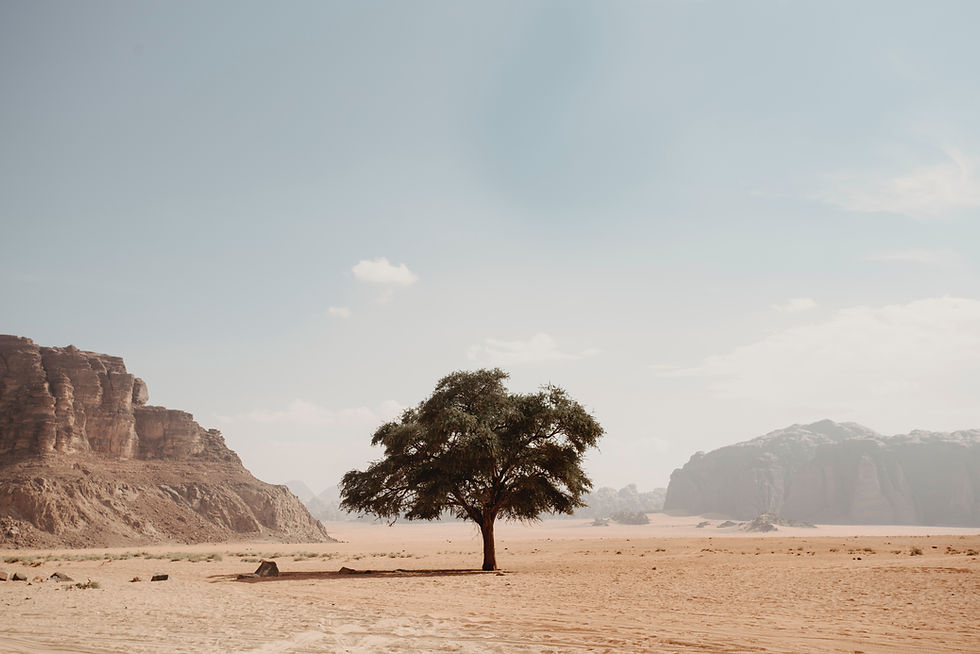
In my last article, I wrote that life had been throwing some strange winds around me. Those winds have not entirely stilled. But today, I begin a new era.
Not because every question has been answered. Not because every wound has closed. Not because I can already explain what the last season meant. A chapter can end before its meaning becomes clear, and sometimes the most honest beginning is made without certainty.
I have made decisions believing I had received answers. I took risks. I changed the shape of my life around what I understood to be direction. Then I arrived at the humbling realization that I might have been wrong all along.
Perhaps I mistook longing for revelation. Perhaps the answer was about having the courage to move, not about the permanence of the destination. Perhaps God allowed me to walk a road because something in me could only be uncovered there. I do not yet know.
What I do know is that there is a particular grief in discovering that the future we obeyed toward is not the future we will inhabit. It wounds more than our plans. It bruises our confidence in our own discernment, and if we are honest, it can bruise our faith in God.
But bruised faith is not absent faith. The prayer, "Lord, I no longer know what I heard," may be more faithful than pretending to possess a certainty we no longer have. God is not threatened by an honest question. He does not stop listening because we were imperfect, because we misunderstood, or because hope once spoke more loudly than wisdom.
Some doors did not open. Yet one remained: an ordinary, demanding, familiar door through which life still asked me to rise, serve, think, create, and be useful. Once, I might have called that merely practical. Now it looks like mercy. Sometimes God does not preserve the door we begged Him to open. Sometimes He preserves the one strong enough to hold us while we rebuild.
The first Bethel
After all I have gone through over the last eight months, I can think of Jacob's story as a map for this kind of return.
Jacob first came to Bethel while running away. He had left his home under the shadow of conflict and fear, and when night came, he slept outdoors with a stone for a pillow. There, at the very moment when his life looked least settled, he dreamed of a ladder reaching from earth to heaven, with angels ascending and descending upon it.
"I am with thee, and will keep thee in all places whither thou goest, and will bring thee again into this land." Genesis 28:15 |
Jacob woke and said, "Surely the Lord is in this place; and I knew it not." He named the place Bethel - the house of God. It became the place where a frightened man learned that exile did not place him beyond heaven's reach.
Then he left. Years passed. Life became complicated. Jacob worked, loved, was deceived, prospered, feared, fled again, wrestled through the night, and walked away from that encounter with both a new name and a permanent limp.
The man who eventually returned to Bethel was not the untested man who had first slept beneath the open sky.
That matters. Scripture does not give us a return story in which nothing happened on the road. Jacob returned carrying evidence of every mile.
The command to return
In Genesis 35, after upheaval and danger, God spoke to Jacob again:
"Arise, go up to Beth-el, and dwell there: and make there an altar unto God." Genesis 35:1 |
God did not tell Jacob to invent a new sacred place. He called him back to the place where he had first recognized that heaven was near. But Jacob could not simply gather everything from the old life and carry it into the new one. Before the household began its journey, he gave three instructions: put away the strange gods, be clean, and change your garments.
Then they handed him the foreign gods they had been carrying, and Jacob buried them beneath an oak near Shechem.
That is where the story becomes more than geography. Bethel is not merely a town on Jacob's map. It is the inner place where identity is reorganized around God.
The oak marks the boundary between the life that has ruled us and the life we are now willing to inhabit.
The gods we carry
An idol is not only a carved object. Psychologically, an idol can be anything we project the power to make us whole onto. It is whatever we ask to answer the unbearable questions: Am I worthy? Am I chosen? Am I safe? Will I be abandoned? Does my life matter?
Human love is sacred, but human attention was never designed to carry the entire weight of our identity. Yet it is easy to place another person on a private throne and ask their loyalty, consistency, admiration, or presence to settle our worth. When their attention turns, our sense of value turns with it. When they withdraw, we feel erased.
The psyche has a haunting way of returning to familiar wounds. We repeat an old emotional situation hoping that, this time, it will end differently: this time I will be chosen; this time love will stay; this time devotion will make me safe.
We are not seeking pain. We are seeking a different ending to pain.
But repetition often wears the clothing of hope. We can spend years inviting new people to audition for the role of the one who will finally prove that the original wound never happened. Each disappointment then feels larger than the present moment, because it awakens every earlier verdict we thought love would overturn.
Bethel interrupts that cycle. It asks us to stop giving human beings a divine assignment. The thing that must be buried is not our capacity to love. It is the belief that another person's attention has the authority to determine whether we are lovable.
Some things cannot be reasoned into harmlessness. They require a burial. The psyche needs symbols because grief is not only an idea; it lives in the body, in routines, in objects, in places, in the reflex to look back.
Jacob did not negotiate with the foreign gods. He did not place them in a box marked "perhaps later." He put them beneath the earth and walked away.
Arise
The first word of God's instruction is arise.
To arise does not mean to feel healed. It means that grief may be visited, but it cannot become our permanent address. Often movement begins before emotion agrees to follow. We stand because life is still asking something of us, because one door remains open, because the next faithful act does not require the whole map.
Go
To leave is to take a risk. We leave the known ache and enter an unknown future. We surrender the identity we built around a promise, a place, a relationship, or a version of ourselves that no longer exists.
But staying is also a risk. There are seasons when remaining at a closed door costs more of the soul than walking away from it. Sometimes the most spiritual act available to us is to stop decorating the door that God is not opening.
Leaving does not declare that nothing mattered. Burial is not denial. We bury what was real precisely because it was real enough to deserve a boundary. We honor the season by refusing to let it consume every season that follows.
Dwell
God told Jacob not merely to visit Bethel, but to dwell there.
There is a difference between arriving somewhere and inhabiting it. We can move physically while continuing to live emotionally between what wounded us and what we hoped would save us. The nervous system cannot heal in a house we refuse to enter.
Dwelling is the quiet work of becoming present again. It is making a bed, keeping an appointment, returning to prayer, doing honest work, caring for the mind and soul, tending the body, accepting friendship, serving someone, and allowing ordinary days to become trustworthy.
Even therapy is not a failure of faith. Sometimes it is one of the rooms in which truth is finally given permission to speak.
We often wait for hope to return before rebuilding. Jacob's story suggests another order: build, and let hope discover that there is somewhere safe to come home to.
Build an altar
An altar is an organizing center. It establishes what the rest of life will face.
To build an altar now may mean reconstructing life around what remains sacred rather than around who remains attentive. It means placing our days under values that do not disappear when someone changes their mind: integrity, work, prayer, truth, compassion, health, responsibility, beauty, service, and the presence of God.
An altar is built one stone at a time. So is a life.
Change your garments
Jacob's household was also told to change its garments. In scripture, garments often mark purification, transition, and identity. Psychologically, we also wear the stories of what happened to us.
We wear the garment of the fool who should have known better. The abandoned one. The one who was too much, or not enough. The person who misheard God. The person whose love could not make someone stay. Shame is remarkably loyal to an old identity; it will keep dressing us for a life that has already ended.
But repentance, at its deepest, is not humiliation. It is reorientation. It is the willingness to turn, to see more truthfully, and to stop punishing ourselves for having once acted with the light we had.
We are responsible for learning. We are not required to hate the person who needed the lesson.
The name the breaking could not erase
When Jacob reached Bethel, God appeared to him again and reaffirmed his name: Israel.
The name had first been given after Jacob wrestled through the night and refused to let go without a blessing. Israel carries the sense of one who persists, or perseveres, with God. Jacob did not arrive at Bethel without a limp. He arrived as a man whose wound had become part of his walk, but not the whole of his identity.
This is one of the most merciful movements in the story. God did not call Jacob by the names his fear, deception, regret, or losses might have given him.
He called him by the name formed in the wrestling.
Perhaps that is what a new era truly is. Not a return to innocence, but an integration of what we now know. Not the promise that no one will ever wound us again, but the growing certainty that we will no longer abandon ourselves when they do - and that God will not abandon us either.
Will we trust another again? Perhaps. But trust cannot be commanded back into innocence. It must be rebuilt with discernment, reciprocity, boundaries, and time. Boundaries are not bitterness. Refusing love that requires self-erasure is not a refusal to love. A guarded season can be holy when it is used not to build a prison, but to restore the gates.
The invitation comes first
There is a small but essential grace in the order of Genesis 35. God told Jacob to arise and return before Jacob had put away the foreign gods, before the cleansing, before the change of garments, before the altar.
The invitation came first.
We do not become perfect enough to go back to God. We go back because He has called us while we are still sorting through what we carried. He listens to imperfect people. He speaks to confused people. He receives bruised faith. Grace is not the prize at the end of a flawless interpretation of His will; it is what makes return possible when we discover how little we understood.
Being wrong about a road does not prove that God was absent on it. Jacob himself said that God had answered him in the day of his distress and had been with him "in the way which I went." Scripture does not say that every mile was simple, painless, or perfectly understood. It says that he was not alone in the way.
Beneath the oak
So, again... Today, I begin a new era. Not because my faith is unbruised. Not because grief has finished its work. Not because I possess a bright explanation for every door that remained closed.
I begin because one door is still open. I begin because a life can be rebuilt before it can be explained. I begin because the voice that called Jacob did not say, "Defend yourself." It said, "Arise."
When we are standing at a crossroads, we do not need to see the entire road. We can look for the door that is still open. Gather what remains true. Name what has been ruling us. Bury the belief that someone else must choose us before we are allowed to have a life. Change the garments of shame. Return to the place where God first taught us that heaven was nearer than we knew. Build an altar from the ordinary stones of the days ahead.
And if all you can carry there is bruised faith, carry that. God recognizes faith even when it arrives limping.
Some things belong beneath the oak: the future that never arrived; the apology that may never come; the fantasy that enough love could make another person's choices safe; the verdict that being left means being unworthy. Bury them - not because they did not matter, but because they have mattered too much to rule the life that comes next.
Then rise.
At Bethel, God will not ask us to become who we were before the breaking. He will call us by the name the breaking could not erase.
Beneath the oak lies what could never save us.
At Bethel stands the God who never misplaced us.
And the road between them is not our defeat.
It is the way home.
Some things must be buried beneath the oak. Some garments must never be worn again. And some roads lead us home—not because the past is waiting for us, but because God is.
Scripture references:
Genesis 28:10-22;
Genesis 32:24-31;
Genesis 35:1-15.
Quotations follow the King James Version.


Comments